Baby Bird Distress Call in a Smart Chip
Published May 6, 2019
What to do When You Discover Birds or Wildlife in Distress
Does that baby bird or rabbit in your grand really demand rescuing?
"There are some things nosotros can set up the yearly clock by," says Audubon refuge managing director and naturalist Kim Calcagno. Each wintertime, she fields scores of phone calls about weak and emaciated water birds like Canada Geese, loons, grebes, and ducks. This past wintertime, the calls came through in the hundreds. But her piece of work is far from over.
Throughout spring and summertime, when people spot baby birds outside of their nests, Calcagno'south telephone volition light up again and again. Babe birds are often at the mercy of peculiarly persistent myths. Some people believe, for instance, that a infant bird cannot be reunited with its parents if it's fallen out of a nest. Simply nothing could be farther from the truth.
"Parent birds invest a lot of fourth dimension and free energy in their babies, and won't surrender on them hands," Calcagno says. "Even if a storm destroys a nest, the parents fly around for days looking for their young. Information technology's easier than most people think to reunite baby birds with their parents."
Most people don't know that raising baby birds is highly specialized and demanding. Babe birds demand to be fed every 15 minutes from dawn until sunset. Calcagno, who has spent time rehabilitating infant birds, describes the experience as enough to make a person sick from exhaustion. When it comes to raising salubrious nestlings, there is no replacement for devoted parents and a community of birds.
When information technology comes to situations where intervention is warranted however, choosing how and when to arbitrate can be complicated. There is no simple set of rules to follow. That's why the Audubon Society of Rhode Island urges people to telephone call an skillful earlier trying to help a bird or beast that appears to be injured or orphaned. The truth is, a lot of supposed "rescue missions" carried out by non-experts are well intentioned simply misguided, and ultimately harmful to wild fauna. Sometimes it is helpful to intervene, just just every bit ofttimes, nature should be left to its own, at times unforgiving, means.
An skillful should always be consulted earlier intervening with wildlife.
Found an creature in distress?
Audubon offers expert advice on what to practise.
- Before intervening in any mode with an animal that appears to be injured or orphaned, monitor it from a distance and make some careful observations: What type of animal is it? If you lot're unsure of the species, note the size, shape, and markings on the beast. Is it an adult or a baby? Where is information technology located? Did you encounter information technology moving? If it's not moving, how long has it been in the same spot? Has anyone touched the animate being? What obvious injuries exercise you see? If known, what is the reason for the injury?
- Call Audubon at (401) 949-5454 or the Rhode Island Wild fauna Dispensary at (401) 294-6363 for guidance before intervening. If no one is available to answer your call, visit www.riwildliferehab.org for helpful data or our "Inquire Audubon" page.
- During normal hours of operation, injured animals may be brought to the Wildlife Clinic at 2865 Tower Hill Road (Route 1) in Saunderstown, R.I. Do not go out animals if the clinic is non open up.
Please note that Audubon is not licensed to have injured wild fauna.
Answers to common questions are listed beneath.
A baby bird out of its nest, with no visible injuries: If the bird doesn't have feathers and y'all can accomplish the nest, put information technology back. Your affect will non crusade the mother to abandon the baby. If you can't reach the nest, Calcagno advises tacking a pocket-sized handbasket—like a pint-sized strawberry basket—to the tree, or every bit close to the nest as possible, and placing the infant bird gently in the basket. If the bird has feathers, leave information technology lone and monitor it. Juvenile birds that appear to be lonely and incapable of flight are not necessarily injured or abandoned. A fledgling will hop effectually on the ground for a while earlier it learns to fly, and yous may observe its parents coming around every 45 minutes or then to feed information technology. In the meantime, the best affair is to exit the bird alone and not attract the attention of predators to information technology.
An injured or orphaned raccoon, skunk, bat, trick, or woodchuck: Never touch these animals. Secure all pets indoors. Keep children away. These are rabies vector species. Call the Department of Environmental Management at (401) 222-3070 or your animal control officer. If a person has skin-to-fur contact with these animals, the person must exist vaccinated and the brute must be euthanized.
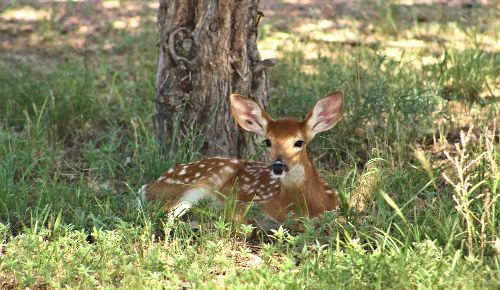
A fawn solitary in the bushes, or at the edge of the woods, calling out: Don't attempt to movement the fawn, and monitor it from at to the lowest degree 40 feet away. Annotation how long has the fawn been calling for its mother. A mother deer will leave her fawns to go off and forage. Since her babies are built-in without a scent, they may remain undetected and the mother expects to find them in the same place when she returns. If the fawn is up on its anxiety and running around, is visibly distressed or injured, or has been calling for a half-hour or more, telephone call the Wildlife Clinic.
A rabbit nest that seems abandoned: It's best to observe this nest from a distance and non describe attention to it. Chances are, that's exactly what the mother of the immature rabbits has in mind. She'll just return to the nest briefly at dawn and at sunset. If she saturday on the nest for any length of fourth dimension, her presence would be a blood-red flag to predators.
An orphaned infant squirrel, bird, or rabbit: Do non feed the animal or bring information technology into your home. Call the Wildlife Clinic or Audubon immediately. Mere hours can mean the deviation between a relatively healthy baby animal and one that has suffered and so much that information technology cannot be saved.
christopherting1950.blogspot.com
Source: https://asri.org/news-events/articles-2019-01/what-to-do-when-you-find-birds-or-wildlife-in-distress.html
0 Response to "Baby Bird Distress Call in a Smart Chip"
Post a Comment